


#BIOSPAIN2026 | Bioregions highlight their role in boosting the competitiveness of European biotechnology
Representatives from the biotech ecosystems of the Basque Country, Catalonia, the Valencian Community, the Balearic Islands and Galicia discuss the role of clusters in connecting capabilities, accelerating sector growth and strengthening collaboration between regions.
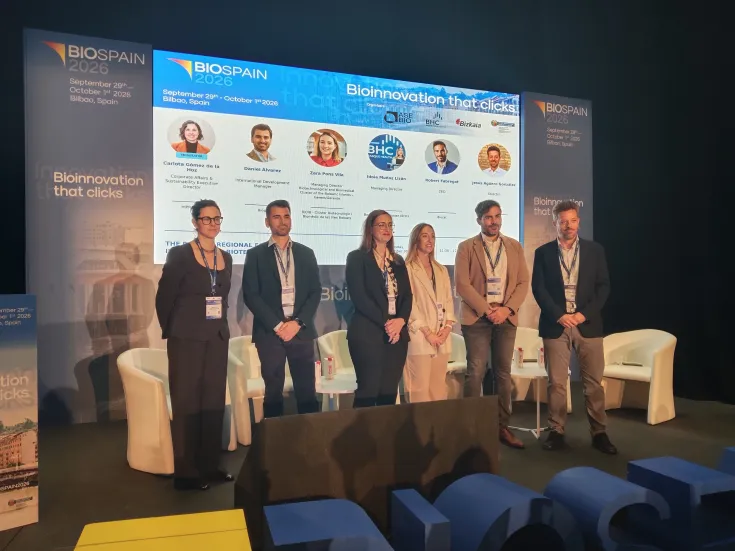
The competitiveness of European biotechnology depends not only on generating science and innovation, but also on the ability to connect and leverage the strengths of the different ecosystems that make them possible. In this context, clusters and bioregions are playing an increasingly strategic role, connecting companies, research centres, universities, hospitals, investors and public administrations to transform regional scientific and technological capabilities into innovation, business growth and new value chains.
The Biotech Act itself places this collaboration between ecosystems at the heart of the European debate, promoting biotech cluster networks as a tool to generate synergies, share capabilities and strengthen the sector’s competitiveness. BIOSPAIN 2026 brought this debate directly to its protagonists during the session “The Role of Regional Ecosystems in Driving the Biotech Sector”.
The session brought together Idoia Muñoz, Director of the Basque Health Cluster; Robert Fabregat, CEO of Biocat; Jesús Agüero, Director of Bioval; Zara Pons, Managing Director of BIOIB; and Daniel Álvarez, International Development Manager at Bioga. The session was moderated by Carlota Gómez, Third Vice-President of AseBio and Corporate Affairs and Sustainability Executive Director at HIPRA.
Different ecosystems, complementary strengths
The discussion highlighted how Spain’s bioregions have developed ecosystems with different characteristics, capabilities and degrees of specialisation, creating opportunities for greater complementarity between regions.
In the Basque Country, Idoia Muñoz highlighted the ecosystem’s strong industrial dimension and its connections with a network of clusters, technology centres, research organisations, the healthcare system and public administrations. This industrial and manufacturing culture also extends to biotechnology, enabling capabilities developed in sectors such as automotive and aeronautics to generate new opportunities in health.
Robert Fabregat identified scientific excellence, the healthcare system and Barcelona’s ability to attract international talent and entrepreneurship as some of Catalonia’s main strengths. The ecosystem includes nearly 100 research institutions and around 500 startups linked to the sector. However, he also pointed to challenges including the high concentration of capabilities in Barcelona and the need to strengthen manufacturing capacity and company scale-up.
According to Jesús Agüero, the Valencian Community offers an ecosystem characterised by its diversity, with capabilities in areas including food biotechnology, green biotechnology and health. Bioval currently brings together around 150 organisations, including companies and research centres, and has identified 25 new companies — SMEs and startups — over the past two years. The challenge now is to accelerate knowledge transfer into new companies and facilitate their subsequent scale-up.
From the Balearic Islands, Zara Pons argued that innovation can also emerge in smaller ecosystems when the right conditions are in place. Among the region’s opportunities, she highlighted its ability to attract international talent and bring back professionals who have trained outside the islands, as well as the emergence of areas of specialisation such as longevity and healthy ageing.
Finally, Daniel Álvarez highlighted the rapid transformation of the Galician ecosystem over the past decade, supported by successive regional strategies, growth in public and private investment, and the cluster’s role as a connector between academia, industry and public administration. Galicia’s new strategy to 2030 aims to mobilise close to €1 billion in public and private investment to continue strengthening the sector.
Talent: the challenge is not only attracting it, but finding the profiles industry needs
Talent also featured prominently in the discussion. Representatives of the bioregions agreed that the challenge does not necessarily lie in a general shortage of professionals, but rather in the difficulty of finding certain specialised profiles, particularly in regulatory affairs, market access, business development and management.
Clusters can play an important role here by connecting companies’ needs with universities, training centres and public administrations, contributing to the development of new programmes and skills. At the same time, participants stressed the need to retain existing talent, bring back professionals currently pursuing their careers outside Spain and attract international profiles.
The discussion also showed that circumstances vary across regions. While Catalonia faces the challenge of maintaining a balance between talent in public institutions and a growing private sector, the Balearic Islands have highly qualified professionals who want to return but still find limited scientific and business opportunities.
Clusters as gateways to ecosystems
Beyond regional differences, participants agreed on one common function: connecting capabilities that might otherwise remain isolated.
Muñoz described clusters as true “gateways to the ecosystem”, enabling companies to identify knowledge, talent, infrastructure, funding and partners. This role is particularly relevant for SMEs, which have fewer resources to identify all the capabilities available to them.
Along the same lines, Pons highlighted the value of clusters as a “neutral umbrella” capable of building trust and bringing companies, researchers, universities and public administrations around the same table.
Fabregat explained that Biocat performs this role through a different model, as a public-private foundation that seeks to provide an overall view of the ecosystem, identify gaps and reduce friction between its different players. The objective, he explained, is not to duplicate activities already carried out by other organisations, but to identify what is missing and work together to address those gaps.
This intermediary role also produces tangible results. Galicia highlighted how listening directly to companies’ needs and conveying them to public administrations has helped develop support instruments, including initiatives designed to facilitate companies’ participation in international missions.
From competing between regions to connecting capabilities
One of the key messages from the session was the need to move towards a network of bioregions that combines specialisation and collaboration, avoiding a situation in which every region attempts to develop independently all the capabilities required to compete.
Participants stressed the importance of identifying more precisely which capabilities, infrastructure, talent and areas of specialisation exist in each region, as well as their main gaps, in order to build complementarities and make these resources available to companies from other regions.
This collaboration is already beginning to take shape among Spanish clusters. During the session, participants shared examples of companies being referred to other bioregions when more specialised capabilities are available there, from aquaculture in Galicia to specific agri-biotech capabilities in the Valencian Community or investment resources and industrial capabilities in the Basque Country.
“Cooperate, not compete” was one of the ideas put forward by Muñoz, who stressed that Europe already has talent, innovation, factories and manufacturing capabilities that can be connected to strengthen its global position.
Fabregat argued that, faced with competitors such as the United States and China, Europe cannot operate as 27 separate ecosystems each aspiring to possess every capability individually, just as Spain does not need its 17 autonomous communities to replicate the same resources. The alternative is to build a genuine map of capabilities and a network that enables infrastructure, knowledge and talent to be shared and makes it easier for innovation to move between regions.
“We don’t need to do everything everywhere”
The session therefore left one central message: specialising ecosystems does not mean limiting access to innovation, but rather making better use of available resources so that innovation can go further.
Capital, talent and infrastructure are limited resources. Identifying where the most competitive capabilities are located, connecting them and making them accessible to companies from other regions can help accelerate business development and avoid unnecessary duplication.
Representatives of the bioregions also agreed that this cooperation needs to move faster. Technological innovation is evolving at an increasingly rapid pace, and Europe needs to reduce the time required to transform knowledge into solutions, companies and market opportunities.
In this context, clusters are expected to play an eminently practical role. As highlighted at the close of the session, “clusters should not become an administrative layer, but an operational layer”, capable of creating the conditions for innovation to move faster.
The challenge, therefore, is to maintain healthy competition between regions while deepening collaboration. Connecting the strengths of different bioregions, sharing capabilities and working from a common perspective will help build Spanish and European biotech ecosystems with greater scale, speed and ability to compete globally.