


Promising results for GAT Therapeutics drug in development for pulmonary fibrosis
The biotech company GAT Therapeutics, based at the University of Barcelona Parc Científic de Barcelona (PCB-UB), is making progress in the development of GTX-11, a new oral drug candidate for the treatment of idiopathic pulmonary fibrosis (IPF).
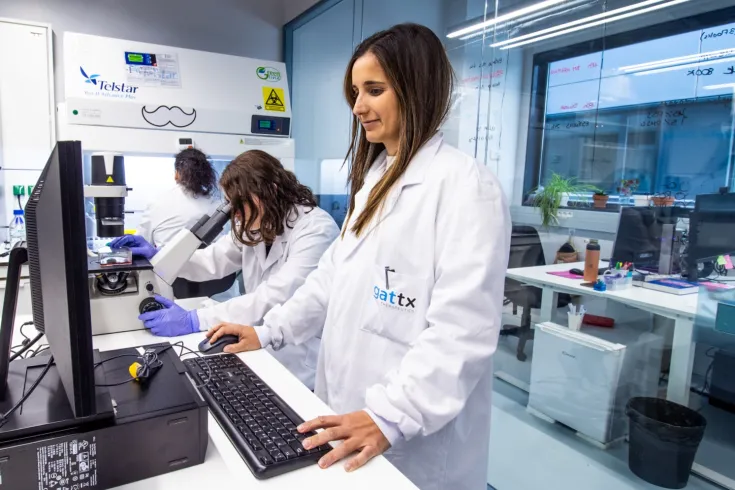
The research has been carried out in collaboration with the group led by Dr Maria Molina-Molina from Hospital de Bellvitge and the Bellvitge Biomedical Research Institute (IDIBELL), and the group led by Dr Javier Milara at the Fundación de Investigación del Hospital General Universitario de Valencia (FIHGUV) and the University of Valencia (UV), which have provided key capabilities in cell biology and advanced experimental models. Both groups are international references in translational research in respiratory diseases. In particular, the participation of Dr Molina, a recognised expert in interstitial lung diseases, has reinforced the clinical relevance of the study.
The results obtained confirm the therapeutic potential of GTX-11, which in the models studied was able to significantly reduce pulmonary fibrosis, inflammation and vascular remodelling. In certain experimental parameters, their effects have been comparable or even superior to those observed with treatments currently used in clinical practice, nintedanib and pirfenidone.
In these preclinical studies, GTX-11 has been shown to improve survival in an experimental of bleomycin-induced pulmonary fibrosis. The treatment significantly reduced pulmonary inflammation, limited the vascular alterations associated with the disease and reduced the activation of cells responsible for the formation of scar tissue, responsible for fibrosis. These effects are related to its ability to decrease TGF-β1 pathway signalling, a key cytokine in the development of fibrosis, resulting in less scarring, less inflammation and a possible delay in disease progression.
The study also has assays in human cells from both healthy lungs and patients with fibrotic interstitial lung disease, reinforcing the clinical relevance of the results.
For Dr Maria Molina, scientific director at IDIBELL, head of the research group in Pneumology at the same centre and physician in the Hospital de Bellvitge Interstitial Lung Disease Unit, “one of the most relevant aspects of the study is to have validated the anti-fibrotic effect in primary fibroblasts derived from patients with interstitial disease. In these cells, GTX-11 consistently reduced the profibrotic response, in addition to decreasing the production of inflammatory mediators. These results reinforce the candidate’s clinical and translational relevance because they show activity in a human model directly related to the biology of the disease”.
“In the bleomycin-induced lung fibrosis model, treatment with GTX-11 not only significantly reduced fibrosis, but also decreased lung inflammation and provided a differential finding: a clear improvement in the vascular dysfunction associated with the disease. This set of results suggests an impact on the three main axes of pathology: fibrosis, inflammation and vascular alterations”, said Dr Milara, researcher at the Research Foundation of the General University Hospital of Valencia (FIHGUV) and the University of Valencia.
The programme is part of the project CPP2021-008747, funded by MICIU/AEI/10.13039/501100011033 and by the Spanish Recovery, Transformation and Resilience Plan (PRTR) through the European Union NextGenerationEU fund.
Safety demonstrated in humans: successful completion of Phase I
In parallel to preclinical development, GAT Therapeutics has recently successfully completed the Phase I clinical trial (GTX-PH1-001). The study, conducted in healthy volunteers, confirmed that GTX-11 has a favourable safety and tolerability profile, allowing us to characterise its pharmacokinetics and lay the groundwork to advance towards safety and efficacy studies in patients.
This milestone reinforces the translational strength of the programme, which already has strong preclinical efficacy and early clinical safety results. “These results validate years of research focused on intervening on the mechanisms that drive fibrotic progression. Having demonstrated safety in humans after successful completion of Phase I successfully puts us in a strong position to move forward to studies in patients. GTX-11 is destined to become a safe and truly disease-modifying therapy”, said Eugènia Ruiz, CSO of GAT Therapeutics and author of the study.
GTX-11, a new hope for a disease with limited therapeutic options
Idiopathic pulmonary fibrosis is the most common form of fibrotic interstitial lung disease and is characterised by a progressive loss of respiratory function. It is a serious and unpredictable pathology that affects thousands of people worldwide, mainly older adults. Life expectancy after diagnosis is only two to five years and, despite medical advances in recent years, the scientific community agrees that it continues to be a disease without a cure and with unmet medical needs. Therapeutic options are limited and, in the most advanced cases, lung transplantation remains the only curative alternative.
In this context, GTX-11 offers a new avenue of research. It is an orally administered drug developed from a marine carotenoid called fucoxanthin, a natural substance present in certain algae that has aroused scientific interest due to its role in inflammation and fibrosis processes. Studies demonstrate the ability of GTX-11 to slow the progression of lung fibrosis by reducing fibroblast activation, the cells responsible for lung damage, and limiting the accumulation of scar tissue. These results reinforce its potential as a future therapeutic option for a disease that still has few alternatives.
Towards effective treatments with fewer adverse effects
One of the main challenges in pulmonary fibrosis is to develop therapies that maintain anti-fibrotic efficacy while minimising the adverse effects associated with current treatments, which limit patients’ adherence and quality of life.
GAT Therapeutics’ approach focuses on intervening on key biological mechanisms in a modulatory and non-aggressive manner, seeking to restore cellular balance rather than indiscriminately blocking physiological pathways. This strategy could result in more effective and better-tolerated treatments.
The combination of strong preclinical evidence and confirmation of safety in humans places GTX-11 as one of the most promising emerging programmes in the field of fibrotic lung diseases. In fact, the journal Nature has recently echoed this line of research in an article on the evolving therapeutic landscape in idiopathic pulmonary fibrosis, highlighting the scientific and translational relevance of strategies that seek to intervene earlier and more precisely in the biological mechanisms that drive fibrotic progression. This recognition reinforces the value of approaches that go beyond symptomatic control to truly disease-modifying therapies, such as GTX-11.
Next steps: Phase II and new investment round
Following the successful completion of Phase I, GAT Therapeutics is preparing to initiate a Phase II clinical trial to evaluate the safety, tolerability and efficacy of GTX-11 in patients with idiopathic pulmonary fibrosis. To this end, the company is structuring a new investment round aimed at financing clinical development and accelerating the programme’s international positioning.