


ADmit Therapeutics predicts progression to Alzheimer's dementia 14 years in advance
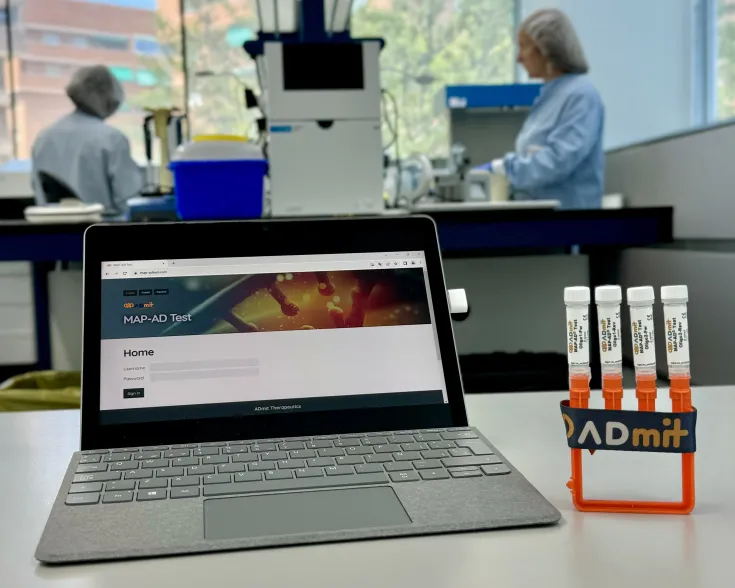
From October 29 to November 1, the biotechnology company ADmit Therapeutics presented its latest results at the “Clinical Trial Alzheimer Disease” (CTAD) held in Madrid. These data confirm the capacity of the MAP-AD® Test technology, developed by the company, to predict the evolution of Alzheimer's Disease Dementia (ADD) 14 years in advance, based on a combination of epigenetic and clinical data of the patient treated by “Machine Learning”.
The test developed by ADmit Therapeutics for the prognosis of the evolution to ADD is applied to patients with Mild Cognitive Impairment (MCI with CDR of 0.5), and the data on age, Sum-of-Boxes test, ApoE genotypes and epigenetic regulation of mitochondrial DNA analyzed with Next Generation Sequencing (NGS) techniques. These data are processed by a classification model generated from a “Machine Learning” process. Using this technology, it is able to detect the evolution to ADD even in individuals who have shown a negative PET Scan for β-amyloid, with excellent precision, sensitivity and specificity from a simple blood sample. In this way, ADmit Therapeutics achieves a completely cost-effective and minimally invasive test (no PET Scan or cerebrospinal fluid extraction is required).
ADmit Therapeutics is a company dedicated to the study of AD and other neurodegenerative diseases with a strong social vocation. It emerged at the end of 2017 as a spin-off of the IDIBELL research center in Barcelona (in the Bellvitge University Hospital). Its objective has always been to develop a tool for the early detection of AD in clinical practice and thus contribute as much as possible to the development of curative therapies.
To this end, it offers a completely new and disruptive approach to understanding the progression of AD as it combines the analysis of susceptibility factors and biological risk with clinical biomarkers and molecular analysis by NGS of the epigenetic regulation of mitochondrial DNA.
The involvement of mitochondria as a key element in the development of AD was already stated in the “Alzheimer's Disease Mitochondrial Cascade” theory 20 years ago by Professor Russell Swerdlow, current scientific advisor to the company.
This approach allows ADmit Therapeutics to avoid the etiological heterogeneity of Alzheimer's and, through its capacity for early triage and stratification of patients, to support the challenges that AD faces in the coming years, such as the increase in patient numbers, the need for more precise and early diagnoses, and data-driven patient management, all aimed at personalized medicine for Alzheimer's patients.
ADmit Therapeutics aims to change the social impact that this disease has on patients and their families, offering the possibility of improving their quality of life with personalized treatment strategies, offering clarity and direction that allow better planning and well-being for those affected and promoting a better understanding of the disease by reducing stigma and promoting a culture of empathy and support for patients and their families.