


AseBio leads a key Work Package in the european ShapingBio project to drive innovation in the bioeconomy
AseBio has played a leading role as the head of Work Package 3, “Testing and Implementation,” one of the core pillars of the project.
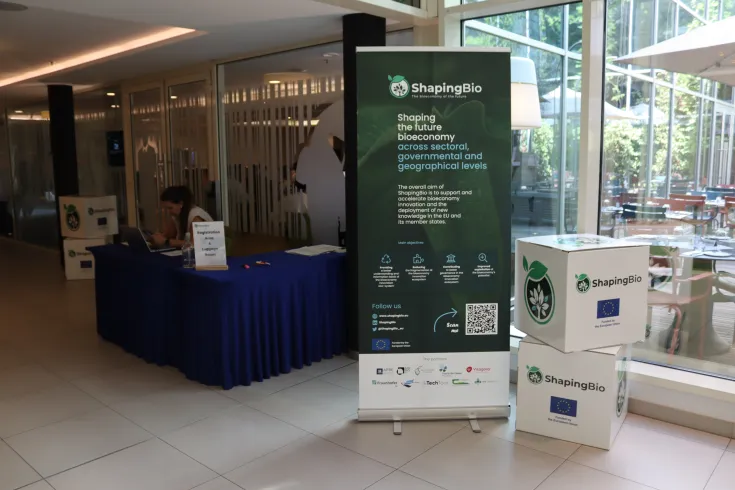
AseBio strengthens its commitment to the development of the bioeconomy in Europe by actively participating in the ShapingBio European project, a strategic initiative focused on promoting innovation in this key area for the continent’s sustainability and competitiveness.
The objective of ShapingBio is to provide a roadmap that enables better alignment of public policies, institutional structures, and funding instruments related to the European bioeconomy. To achieve this, the consortium—made up of 10 partners from 9 European countries—has worked on mapping and analyzing the current state of the sector, as well as defining strategic actions to foster a more efficient, inclusive, and interconnected bioeconomy.
In this context, AseBio has played a leading role as the head of Work Package 3, “Testing and Implementation,” one of the central components of the project. This responsibility has involved coordinating activities aimed at validating, implementing, and assessing best practices related to stakeholder engagement in bioeconomy-related initiatives.
The work led by AseBio has made it possible to synthesize key learnings derived from practical implementation experiences across various European countries and contexts. As a result, a strategic deliverable has been produced, outlining 11 core principles and best practices. The goal is to offer a practical, transferable tool to improve the quality and impact of participatory processes in the bioeconomy, even beyond the scope of the ShapingBio project itself.
Among the identified principles are the need to design participatory processes tailored to specific territorial contexts, to foster transparency, to ensure representation and diversity among stakeholders, and to guarantee the traceability of outcomes. These recommendations are aimed at public policy makers, businesses, scientific institutions, and social organizations, and are based on real-world experiences that have proven effective in different European countries, including Spain.
Moreover, this work has had a strong practical and results-oriented focus. Throughout the work package, AseBio promoted the testing of these best practices in various participatory formats, such as workshops, innovation labs, consultative sessions, and multi-stakeholder forums, contributing to robust evaluation tailored to diverse national realities.
The impact of this work has been especially relevant in today’s context, where the bioeconomy is emerging as one of the key pillars in addressing major 21st-century challenges such as climate change, food security, energy transition, and sustainable resource management. In this regard, the outcomes of Work Package 3, led by AseBio, contribute to ensuring these transformations take place with stronger stakeholder involvement and better adaptation to local needs.
AseBio’s experience in leading this work package not only demonstrates its technical and strategic capabilities but also consolidates its position as a European benchmark in promoting innovative, inclusive, and science-based policies. AseBio has played a fundamental role in ensuring that the principles identified are not merely theoretical but are translated into practical tools for public and private entities seeking to improve bioeconomy governance.
With this contribution, we reaffirm our commitment to a transformative bioeconomy based on knowledge, sustainability, and collaboration. The results obtained within the framework of the ShapingBio project will now be shared with the European community, opening new paths for implementing solutions that optimize regulatory, financial, and participatory frameworks across Europe.