


Metagenomics Applied to Olive Grove Cultivation
The results will provide essential data for field monitoring, soil management, and production improvement.
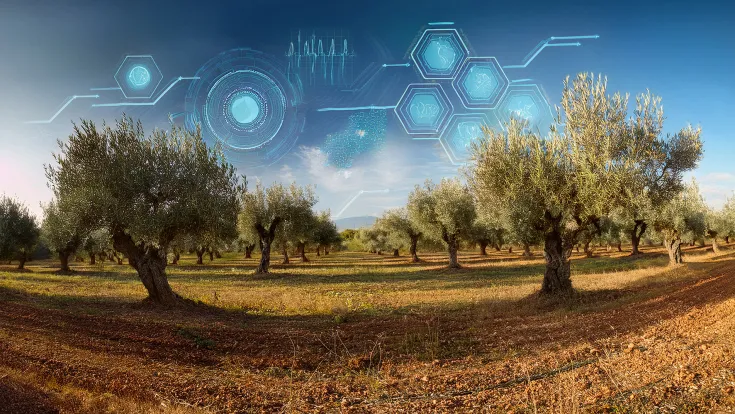
Helix BioS, , in collaboration with the multinational company AGQ Labs and the University of Seville, is carrying out a data analytics project based on NGS metagenomic techniques aimed at improving soil management and productivity in olive grove cultivation. The results will provide essential data for field monitoring, soil management, and production improvement.
The Soil Microbiome: A Foundation for Sustainable Agriculture
Multiple factors influence olive grove productivity, among which soil-dwelling bacterial populations and their interactions with the plant play a critical role. Through the SoilForecast project, promoted by the multinational company AGQ and funded by the Andalusian Technology Corporation (CTA) and Centre for the Development of Industrial Technology (CDTI), Helix BioS analyzes the olive grove soil microbiome at genetic, taxonomic, and functional levels.
This analysis generates complex datasets that enable the development of predictive models based on Artificial Intelligence and Machine Learning. These models allow for accurate determination of soil composition and dynamics, supporting informed decision-making to enhance crop performance and sustainability.
Advantages of Metagenomic Studies in Agricultural Soils
Using Helix BioS’s analytical platform—based on the integration of physicochemical, biochemical, and taxonomic soil data through mathematical models—it is possible to derive conclusions and predictions that improve and control olive crop productivity. These studies result in:
- More efficient use of resources such as fertilizers and water, reducing consumption, optimizing costs, and minimizing environmental impact.
- Improved crop resilience to drought and adverse environmental conditions.
- Optimization of soil biodiversity through microbiome analysis, leading to more sustainable and ecosystem-friendly agricultural systems.
- Anticipation of soil needs, enabling optimized and significantly more sustainable agricultural management.
Cultivated Soil Sustainability through NGS Analysis Techniques
According to the Food and Agriculture Organization of the United Nations (FAO), 33% of the world’s agricultural soils are currently degraded—a figure that could rise to 90% by 2050, including soil erosion.
Through the development and use of AGQ Labs’ analytical tools, the data generated are analyzed by Helix BioS, which “provides expertise and knowledge in the application of Next Generation Sequencing (NGS) techniques to metagenomics,” according to Dr. Carlos Garrido-Allepuz Herrera, Technical Director of Helix BioS.
“By studying the genetic traces left by soil microbial populations, and through a carefully designed analysis plan adapted to the olive grove ecosystem, Helix BioS is able to accurately describe the bacterial and fungal communities present. This is achieved primarily through the development of curated taxonomic and functional databases built around ecosystem-specific knowledge. These databases reduce analytical noise and yield results that faithfully reflect ecosystem reality,” adds Garrido-Allepuz.
Together, AGQ Labs and Helix BioS offer an innovative service that complements traditional nutritional monitoring based on physicochemical analyses and plant response to fertigation, while generating more comprehensive predictive models of soil behavior and agricultural production to support farmer decision-making.
R&D&I at the Service of Farmers
Understanding the soil microbiome is essential for enhancing agricultural sustainability and productivity. Virginia Sebastián Ibáñez, Data Director at Helix BioS, explains that the SoilForecast project “represents a multidisciplinary challenge with high technical and practical value, combining data collection and analysis from multiple sources to generate actionable agronomic knowledge.”
The integration of agronomic physicochemical and metagenomic data, together with advanced Machine Learning techniques applied by Helix BioS, “makes it possible to unravel the complex relationships between the soil microbiome and olive cultivation. These initiatives not only improve our understanding of agricultural systems, but also transform complex data into practical tools that optimize decision-making,” she explains. This approach promotes sustainability and enhances competitiveness across olive production systems, from traditional orchards to super-intensive cultivation.
These studies provide farmers with biotechnological tools and conclusions aimed at reducing the environmental impact of olive cultivation by optimizing resource use, fostering biodiversity, and conserving soil health. Additionally, they offer actionable insights for managing drought resistance, nutrient availability (such as nitrogen and phosphorus), and disease resistance.
Consequently, microbiome analysis can guide strategies to improve olive tree resilience to climate change, productivity, and olive quality. This technology is also extensible and adaptable to any type of crop.
About AGQ Labs and Helix BioS
AGQ Labs Group is a multinational technology-based company founded in Seville in 1993, operating as a technological center that provides value-added solutions and services across agronomic, food, environmental, mining, and health sectors through its laboratories and specialized advisory areas.
Helix BioS is a pioneering company in the application of next-generation sequencing (NGS) and high-throughput omics data analysis across multiple sectors, including biomedicine, agri-food, mining, and metallurgy. Formed by a multidisciplinary team with extensive research and industrial experience, Helix BioS is headquartered in Spain at the Madrid Science Park, within the Autonomous University of Madrid (UAM) campus, and has a strong presence in Latin America, with offices located in Corpac (San Isidro, Peru).
Helix BioS also applies metagenomics to the study of the human microbiome and its relationship with chronic diseases of the 21st century, enabling advanced biological data analysis and the development of innovative therapeutic strategies through bioinformatics and biostatistics. These metagenomic approaches also show great potential in the agri-food industry and in innovative projects related to biohydrometallurgy and the bioremediation of ecosystems affected by mining activity.