


Diana Morant, Minister for Science, Innovation and Universities: “Biotechnology is a strategic sector for protecting citizens”
- The Spanish Bioindustry Association (AseBio) has organized a conference at the Ministry of Science that brought together leading institutional, political, and industry stakeholders to present a manifesto with 10 key measures to boost Spain’s biotechnology sector.
- “After a year of dialogue with the sector and institutional representatives, today we present a call to action: the time has come to join forces and position Spain as a leader in biotechnology in Europe and the world,” said AseBio’s president, Cristina Nadal.
- “Spain can position itself as a key pillar for European biotechnology investments,” stated Olivér Várhelyi, European Commissioner for Health and Animal Welfare.
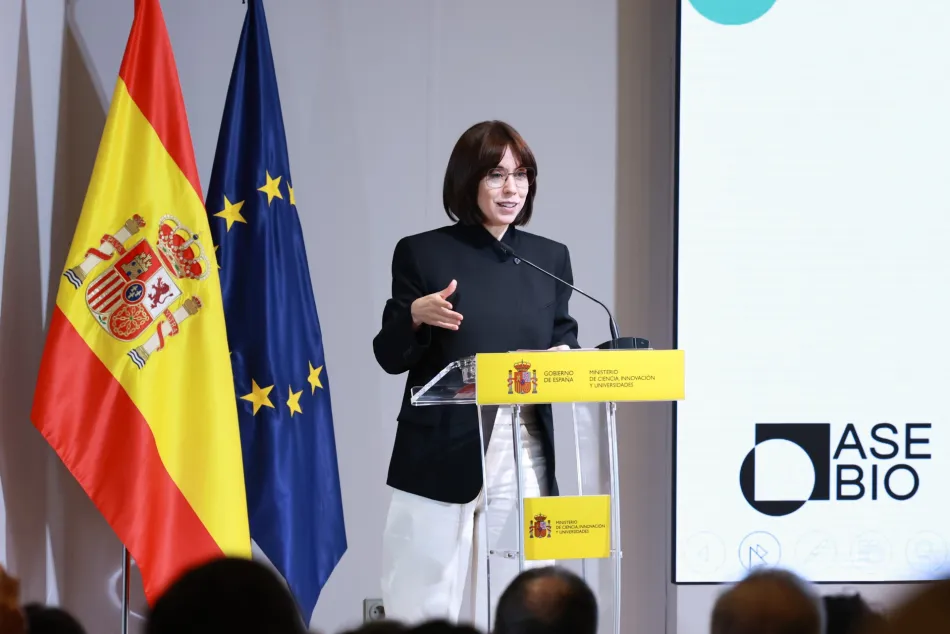
This Tuesday, March 10, the Ministry of Science, Innovation and Universities hosted the conference “The Innovative Biotechnology Sector and Its Role in Strategic Autonomy,” organized by the Spanish Bioindustry Association (AseBio).
The event took place in a geopolitical context marked by profound transformations: the Covid-19 pandemic and the war in Ukraine have highlighted the fragility of European supply chains and dependence on critical sectors. In response, the European Union has made strategic autonomy a priority, identifying deep technologies—such as biotechnology—as essential to ensuring the continent’s competitiveness and security.
Aware of the sector’s innovative potential, AseBio organized this event to bring together leading institutional leaders, policymakers, and members of the biotechnology ecosystem. The goal: to analyze how Spain can help strengthen European strategic autonomy and increase its competitiveness against technological powerhouses such as the United States and China.
“Spain can position itself as a key pillar of European biotechnology investment”
This debate comes at a crucial moment for European biotechnology. Brussels is increasingly aware of its strategic role in the continent’s economic and industrial future—an idea reinforced by the competitiveness reports by Draghi and Letta, which warn that Europe is losing ground to other regions and needs to reindustrialize, strengthen its single market, and decisively invest in strategic sectors such as biotechnology.
“We cannot afford to be the continent where discoveries are made but industrial value is created elsewhere; where our talent is trained and then leaves. If we want to lead in biotechnology, we must act now,” said Olivér Várhelyi, European Commissioner for Health and Animal Welfare, in a video address.
In this regard, Várhelyi highlighted the Biotech Act as a strategic initiative aimed at accelerating innovation to market and creating an environment that allows companies to scale up in Europe, generating jobs and added value. “This is not just another strategic document—it is a competitiveness agenda,” he stated.
“With the right framework, Spain can position itself as a key pillar for European biotechnology investments. If we combine European instruments with national ambition and mobilize private capital, we can redefine the future of health ecosystems in Europe,” he concluded.
10 key measures to position Spain as a global biotechnology leader
During the conference, AseBio presented the manifesto “The Innovative Biotechnology Sector and Its Role in Strategic Autonomy,” the result of an analysis conducted with key industry stakeholders on the role of artificial intelligence in the medicine of the future and biotechnology’s contribution to the challenge of European strategic autonomy. The document outlines ten priority measures to consolidate Spain as a global leader in biotechnology.
Among the proposals is recognizing biotechnology as a strategic sector within Spain’s industrial policy and within the Strategic Reserve of National Capabilities to ensure the supply of medicines and critical products. It also proposes creating a National Network of Biotechnology Scale-Up Hubs with access to bio-manufacturing infrastructure and guidance on GMP processes, as well as developing specific instruments to help biotech companies grow and scale.
The manifesto also advocates accelerating innovation to market through improved data access, faster authorizations, and support within the new regulatory framework for health innovations. In addition, it proposes raising R&D investment to 2.12% of GDP by 2027, placing biotechnology at the center of the National Deep Tech Strategy, incentivizing investment in startups, and strengthening public investment.
Finally, the document includes measures to boost talent, such as a National Talent Plan with industrial doctorates and support for key professional profiles, along with training programs to ensure the responsible use of artificial intelligence within the healthcare system.
“The race for technological leadership is no longer only economic—it is also a matter of national security. Spain has much to contribute, with a sector that represents 1.1% of GDP, generates more than 130,000 highly skilled jobs, and ranks among the top nine global producers of scientific output in biotechnology. After a year of dialogue with the sector and institutional representatives, AseBio is presenting today a call to action: the time has come to join forces and position Spain as a leader in biotechnology in Europe and worldwide,” said AseBio president Cristina Nadal.
More investment, financing, and agile regulation: key challenges for Spain’s biotechnology industry
AseBio also shared the analysis “The New Geopolitics of Biotechnology: Emerging Powers and Established Hegemonies,” which examines Spain’s position relative to the United States, Europe, and China.
The report notes that the United States continues to lead the sector thanks to its market dominance, massive R&D investment, and a dynamic financial ecosystem that drives innovation. Meanwhile, China is emerging as the most disruptive player, with rapid growth in patents, scientific publications, and universities specialized in biotechnology. Europe, while still a relevant actor, has seen its relative position weaken, with a 27% drop in its share of patents between 2010 and 2021, reflecting China’s rapid rise and growing global competition.
Within Europe, the sector’s development also shows clear territorial disparities. Countries such as Switzerland, Germany, the United Kingdom, and France concentrate much of the established industry. At the same time, Spain is consolidating itself as an emerging hub of biotechnology innovation. Although it lacks dominant large corporations, the country has a dynamic ecosystem of small companies and start-ups focused on early-stage research and development. This strength is reflected in its strong scientific output, leadership in clinical trials, and steadily increasing investment, which reached a historic record of €228 million in 2023.
The report stresses that to become a global hub, Spain must increase its R&D investment, ensure financing to scale companies, and establish an agile regulatory framework. Biotechnology is emerging as a strategic sector for Europe’s economic and technological autonomy, and Spain has the necessary elements to lead it—provided it transforms its scientific strength into industrial and business leadership.
Closing the event, Minister for Science, Innovation and Universities Diana Morant emphasized that “Spain can lead the biotechnology revolution in Europe.”
“Biotechnology is a strategic sector for protecting citizens: to guarantee our health, ensure sustainable food systems, and build a cleaner, more resilient industry,” she said.
Ángel Luis Jiménez
Director of Communication
+34 662 172 126
ajimenez@asebio.com
AseBio brings together 350 organizations and represents the entire Spanish biotechnology sector. Its mission is to lead the country’s transformation, positioning science, innovation, and especially biotechnology as a driver of economic growth and social well-being. Among its members are companies, associations, foundations, universities, and technological and research centers that carry out activities directly or indirectly related to biotechnology in Spain.