


AseBio promotes in Brussels the vision of the Spanish biotechnology sector on the Biotech Act I and the future of clinical trials in Europe
Our Director General, Ion Arocena, participated in the latest meeting of the MEP Interest Group “EU Biotech and Life Sciences Alliance” with the aim of bringing clarity and guidance to the European debate.
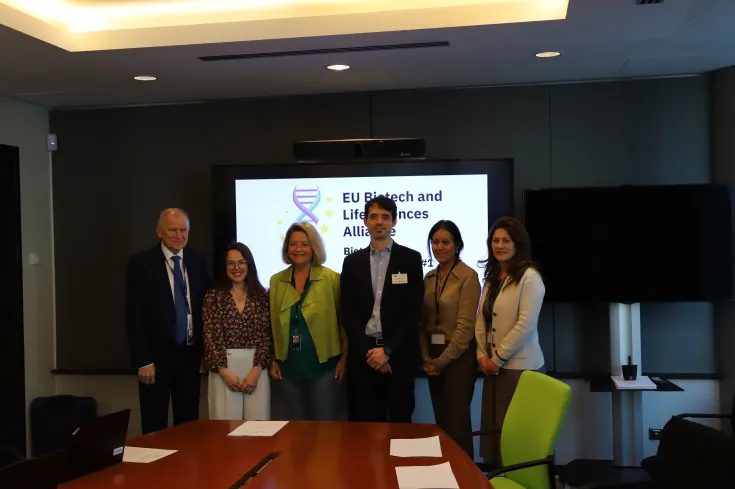
Last Thursday, March 19, the latest meeting of the MEP Interest Group “EU Biotech and Life Sciences Alliance” was held in Brussels. This group, part of the European Parliament, brings together Members of the European Parliament and stakeholders from the sector with the aim of fostering dialogue and developing policies to advance biotechnology and life sciences in Europe. In this context, our Director General, Ion Arocena, took part in the meeting to convey the perspective of the Spanish biotechnology sector on clinical trials and the extension of the Supplementary Protection Certificate envisaged in the Biotech Act I, with the aim of providing clarity and guidance to Members of the European Parliament.
Spain is currently positioned as a European leader in clinical trials and also holds a prominent position globally. This leadership is underpinned by the strength and quality of our National Health System, the excellence of its professionals, and the strong performance of the Spanish Agency of Medicines and Medical Devices (AEMPS). However, this favorable context coexists with significant challenges, such as increasing international competition and the need to better leverage the capabilities of the national ecosystem to boost the clinical development of biotech SMEs.
Against this backdrop, AseBio expressed within the group its support for the European Commission’s objective in the Biotech Act I proposal, focused on accelerating biotechnology R&D in the European Union by simplifying and shortening administrative timelines for the authorization of clinical trials.
In this regard, we particularly value the reduction of timelines for multinational clinical trials, as they are key to recruiting patients across different countries, obtaining robust results, and accelerating the development of innovative treatments. This issue is especially relevant in areas such as rare diseases, where such trials are often the only way to generate scientific evidence.
Likewise, Arocena highlighted the role of the Spanish Agency of Medicines and Medical Devices (AEMPS) in the FAST-EU initiative, conceived as a pilot project to test shorter timelines, improve coordination among agencies, and lay the groundwork for its future expansion at the European level.
In addition, we expressed our support for the removal of the 50-day extension for trials involving advanced therapy medicinal products (ATMPs), as well as for the creation of a centralized dossier to avoid duplication in the submission and evaluation of information in new clinical trials.
However, despite the fact that initiatives such as FAST-EU demonstrate that it is possible to streamline processes and improve coordination, we also pointed out that its current scope is limited by certain eligibility and prioritization criteria. In this sense, FAST-EU is a pilot project that is helping to test best practices which we trust can be scaled up.
Following this positive assessment of the proposed amendments to the Clinical Trials Regulation under the Biotech Act, it was noted that the real impact will largely depend on implementation. In this context, one of the key issues raised during the meeting was the feasibility of meeting the new proposed timelines. To achieve this, we consider it essential to provide adequate resources to both the European Medicines Agency (EMA)and national agencies.
At present, these institutions face several challenges, including difficulties in attracting talent, strong competition with industry for qualified profiles, and a lack of capacity to meet existing and growing demand.
The intervention concluded by emphasizing the need to establish a clear and robust mandate for the European Commission, the EMA, and the Member States, aligned with the ambition of the proposal and supported by the necessary resources to ensure its proper implementation. In this regard, AseBio highlighted that strengthening agencies would particularly benefit SMEs by facilitating faster access to scientific and regulatory advice, improving their interaction with the local ecosystem, and more effectively supporting innovation in biotechnology.