


#BIOSPAIN2026 | Spanish biotech demonstrates its scale-up potential: 67 plants and more than €7 billion in economic impact
New data presented by AseBio at BIOSPAIN 2026 highlight the sector’s industrial potential and provide a starting point for analysing the opportunities offered by the future Biotech Act II to drive scale-up, strengthen biomanufacturing and build competitive value chains capable of translating European innovation into greater manufacturing capacity. Markdown pegado
Europe boasts excellent research, innovative companies and world-class technological capabilities, but it still faces a decisive challenge for its competitiveness: ensuring that this potential translates into greater industrial investment, manufacturing capacity and market opportunities within the continent.
The future Biotech Act II, currently under assessment and development, offers an opportunity to address this challenge from an industrial perspective and move towards an ecosystem capable not only of generating biotech innovation, but also of scaling it up, manufacturing it and bringing it to market in Europe.
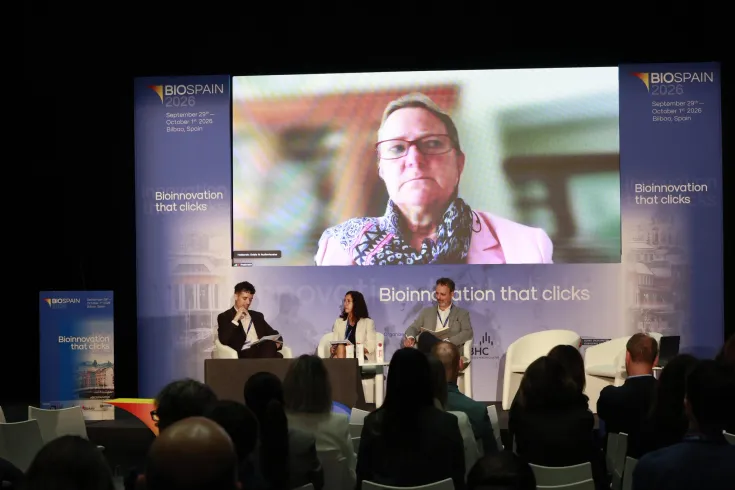
This challenge was at the heart of the BIOSPAIN 2026 session “Biotech Act: Accelerating Biotech Scale-Up and Building Competitive Value Chains in Europe”, moderated by Ion Arocena, General Manager of AseBio, with the participation of Kristin Schreiber, Director of Chemicals, Bioeconomy and Retail at DG GROW, European Commission; Miguel Gómez-Pavón López, General Manager Directorate-General for Industrial Strategy and SMEs at the Spanish Ministry of Industry and Tourism; and Ana Maria Bravo-Angel, Chair of EuropaBio’s Industrial Biotechnology Council.
Spain has industrial capacity, but the challenge is scaling up
As a starting point for the discussion, AseBio presented the main findings of a forthcoming study on the industrial capabilities of its members, providing a clearer picture of existing manufacturing capacity and some of the main challenges to its growth.
The results identify 56 organisations with a total of 67 industrial plants. Seventy-five percent have industrial-scale capabilities, while 25% have semi-industrial capabilities. Contract Development and Manufacturing Organizations (CDMOs) also play a prominent role in this ecosystem: nearly half of the organisations identified, 46%, provide these services.
By area of activity, 70% operate in healthcare, including 23 biologics manufacturing plants, while a further 22% operate in industrial biotechnology, in areas such as bioprocessing and waste valorisation.
The impact of these capabilities exceeds €7 billion, equivalent to 0.44% of Spain’s GDP, and supports 95,000 jobs.
The study also includes an indicator to assess organisations’ scalability based on three dimensions: costs relative to revenues, capacity to increase sales, and capital requirements. The results show that more than half have favourable scalability indicators, with smaller companies showing the highest degree of scalability.
These data provided the starting point for one of the central questions of the discussion: what does Europe need to turn these capabilities into greater investment, scale-up and industrial production?
From the lab to the factory: four conditions for scaling up in Europe
From the perspective of Spanish industrial policy, Miguel Gómez-Pavón López identified this transition as one of the main challenges. Spain has a base of more than 1,100 companies whose main activity is biotechnology, but the question, he noted, is how many of the technologies they generate ultimately reach an industrial facility and a stable market.
To move forward, he identified four priority areas: access to pilot and demonstration facilities, financing tailored to different stages of development, clear and better coordinated administrative frameworks, and sufficient demand to enable viable business models.
This is particularly relevant for small and medium-sized companies, which need to find the right capabilities to advance their development without those capabilities necessarily being available in their own region. Gómez-Pavón therefore argued that Europe does not need to replicate every capability in every territory, but rather to better understand its existing industrial infrastructure and connect it effectively.
In this regard, he noted that the European Cluster Collaboration Platform has more than 1,250 registered clusters, but stressed the need to move beyond indicators focused on meetings or activities towards results capable of measuring the industrial connections that are actually generated. In Spain, he added, there are more than 250 registered alliances with potential for collaboration between different stakeholders, but only around 4% are linked to production.
Biotech Act II will focus on industrial biotechnology and biomanufacturing
From the European Commission, Kristin Schreiber explained that the future Biotech Act II will have a specific focus on industrial biotechnology and biomanufacturing, with the aim of jointly addressing some of the obstacles currently hindering the scale-up of European companies.
Schreiber highlighted the significance of Europe beginning to consider biomanufacturing as a strategic technology, with implications that go beyond any single sector and require connections between industrial, bioeconomy, sustainability, single market and circular economy policies.
This approach means looking at the entire value chain: from the availability and affordability of biomass to regulatory and permitting procedures, infrastructure for testing and scaling new technologies, and the existence of markets capable of absorbing the resulting products.
The Commission is also working on different instruments to facilitate scale-up financing. These include the Bioeconomy Investment Deployment Group, which brings together financial institutions, venture capital funds and institutional investors; the Scale-up Europe Fund, aimed at European companies in later stages of growth; and the proposed future European Competitiveness Fund, designed to support the journey from scientific research through industrial production, market launch, large-scale deployment and manufacturing.
Creating a market for biomanufacturing
One of the session’s most important messages was that boosting supply will not be enough unless Europe also succeeds in generating demand for new bio-based and biomanufactured solutions.
Schreiber indicated that this dimension will be at the heart of the future Biotech Act II. The Commission is analysing the creation of lead markets in specific sectors, starting with areas with significant transformation potential such as chemicals, while also looking at plastics, polymers, fibres and textiles, construction products and fertilisers.
Among the potential tools being assessed are tax incentives, contracts for difference, green public procurement and specific measures to stimulate demand, including possible minimum content requirements for materials derived from bio-based feedstocks, biomass, waste, captured carbon or biomanufactured intermediates.
The DG GROW Director stressed that these measures would need to be introduced gradually and accompanied by a transparent timeline that provides companies with the certainty required to make long-term investments. The objective, she explained, is to build a genuine business case for biomanufacturing in Europe, capable of supporting scale-up and progressively reducing costs.
Competing with fossil-based products on a more level playing field
The need to create a market was also one of the key messages from Ana Maria Bravo-Angel, who argued that Europe has the innovation, talent and knowledge required to build a competitive biotechnology sector, but needs to ensure that manufacturing capacity and industrial growth remain on the continent.
Among the barriers identified, she highlighted regulatory procedures, access to pilot and demonstration facilities, complex permitting processes, biomass availability, and the need to create a more level playing field between new bio-based solutions and established fossil-based products.
Bravo-Angel focused on the so-called “green premium”: bio-based products initially compete with fossil-based alternatives that benefit from decades of industrial development, optimisation and large-scale production and can therefore offer lower costs.
She also warned of a potential asymmetry: while certain biotech innovations must demonstrate the sustainability of their feedstocks or meet new certification requirements, the fossil-based products they seek to replace are not necessarily subject to equivalent requirements.
She therefore called for a better balance between the precautionary principle and a framework capable of fostering innovation and accepting the risks associated with new technologies, particularly in a context in which multinational companies can decide in which regions to develop and scale their projects.
Financing: a decisive gap for scale-up
Financing emerged as another major bottleneck, particularly at the point when companies need to move from the laboratory to a pilot plant or first industrial facility.
Gómez-Pavón distinguished between the quantity and quality of financing. According to the figures presented during the session, Spanish companies raised more than €100 million last year, but the average ticket was around €7 million — a limited amount when it comes to financing first-of-a-kind industrial facilities.
The gap becomes even clearer in the international context. Gómez-Pavón put financing mobilised in Europe at around €25 billion, compared with more than €220 billion in the United States, a disparity that could ultimately push European companies to seek outside the continent the resources they need to continue growing.
Alongside mobilising more capital, the discussion therefore highlighted the need for financial instruments tailored to the risk profile and specific requirements of each stage of biotech development.
An opportunity Europe must seize now
Additional data presented by AseBio during the session provide a more detailed picture of where some of these obstacles lie. In healthcare, companies identify regulation, financing for long development cycles, specialised infrastructure, talent and acceptance as the main barriers. In agri-food, the key challenges include regulatory uncertainty, consumer acceptance, pressure on final prices, a lack of food-grade infrastructure, financing and digitalisation.
In industrial biotechnology, the main challenge identified is precisely scale-up, constrained by access to pilot plants, difficulties in downstream processing, complex permitting procedures and access to financing.
These challenges take on particular urgency as other regions move forward. Both the United States and China featured in the discussion as reference points in an international landscape where competition to attract investment, industrial capabilities and new technologies is intensifying.
Closing the session, Ion Arocena summarised the challenge by noting that Europe already has both a diagnosis and a roadmap shared by the European Commission, Member States and industry. Biotech Act II now represents an opportunity to turn that roadmap into measures capable of accelerating scale-up, consolidating biomanufacturing and ensuring that a greater share of the innovation generated in Europe can also be manufactured and brought to market from Europe.