CEISA collaborates with the MELiSSA Pilot Plant, an external laboratory of the European Space Agency, located on the campus of the Universitat Autònoma de Barcelona
The project aims to develop a life support system for long duration manned human missions

The MELiSSA Pilot Plant - MPP is an external laboratory of the European Space Agency - ESA, located on the campus of the Universitat Autònoma de Barcelona. The MPP is part of the MELiSSA consortium and is a unique laboratory in Europe for the demonstration and integration of technologies related to life support in space.
This project aims to develop a life support system for long duration manned human missions, such as a base to the Moon or Mars. The basic functions of a life support system are atmosphere regeneration, water recycling and food generation.
To achieve self-sustainability and reduce dependence on Earth, the waste generated by the crew must also be used as resources. As a reference, 30 tons of materials are required for life support in a manned mission to Mars, with 6 people and a duration of 1000 days, which makes the mission impossible now. Therefore, an artificial and self-sustaining life support system is necessary.
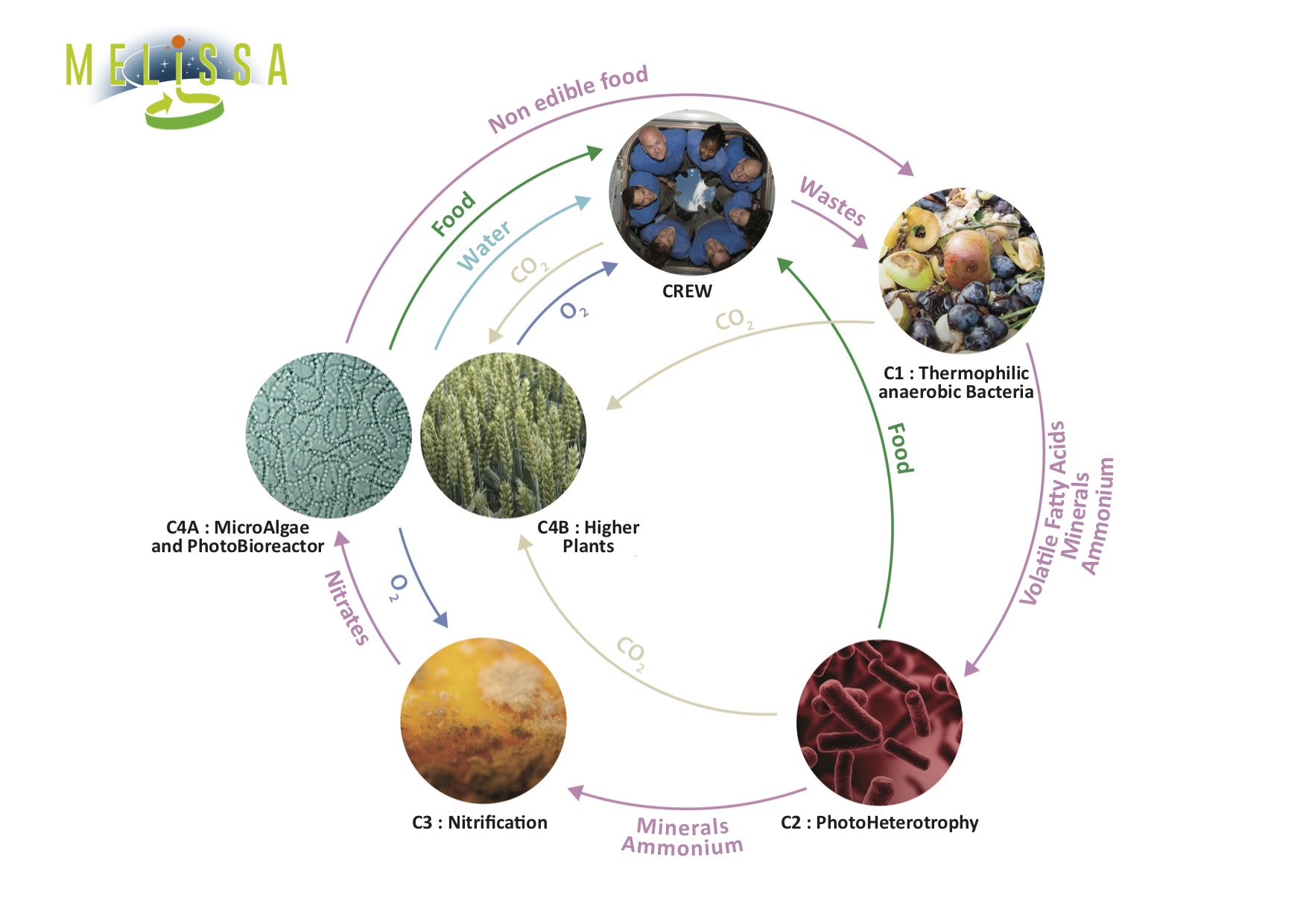
The system proposed by MELiSSA is inspired by a terrestrial ecosystem. From the analysis of the microbiological functions of the system, a structure based on interconnected compartments is proposed, where each one has a specific task. The system is composed of a closed circuit of five compartments: microbiological degradation of organic waste (Compartments 1 and 2), nitrification (Compartment 3), air renewal and cyanobacteria production, as well as plants (Compartments 4a and 4b respectively) and a compartment simulating the crew, an animal isolator (Compartment 5). MELiSSA’s approach is based on the analysis and controlled operation of each compartment as well as of the complete system by means of dedicated mathematical models.
CEISA is currently collaborating in the integration of compartment 4b (photosynthesis and plant food production) and compartment 5 (crew), in gas phase.